

Thirty years ago today, Baz Luhrman’s Romeo & Juliet (1996) was released in the US. Yes 30. Let that sink in. At the time, Venus was in Libra and it was electrified within a few degrees by a trine to Uranus in Aquarius. What a poetic signature to mark the retelling of one of the most famous love stories. Baz Luhrman’s radical editing and dizzying cinematography is infused with Uranian energy. Today on Nov. 1, 2026, I’ll start my own remix of the story analyzing 4 characters through the lens of post-colonial astrology*.
This is the first in a four-part series exploring Venus in domicile and exile through the characters of Romeo + Juliet. We’ll begin with Benvolio’s Venus in Libra, examining how Venus represents not only romantic love, but also civility in relationships and social structures.
In Part Two, we’ll turn to Romeo’s Venus in Aries, where Venus fights for love on the fringes. Part Three brings us back to more comfortable territory with Friar Laurence’s Venus in the garden of Taurus. Finally, we’ll conclude with Juliet’s Venus in Scorpio. Fitting for a fixed sign that rarely starts the fight—but always ends it.
First, a basic primer on the concept of planetary dignities, which serves as a framework for comparing each character. All traditional planets rule a sign. When a planet is in the sign it “rules”, they are cozy. There is a level of ease, comfort, and power. They are fully resourced to live out it’s purposes. For example Venus, a planet that wants to beautify, harmonize, and balance the scales is in her “domicile” in the two signs she rules: Taurus and Libra. In Taurus, she can chill in her garden. In Libra, she builds relationships. When Venus is in the opposite of those signs, she is said to be “in detriment”. Some might call this being “in exile”—a familiar theme in this play. Being in exile promises friction, if not struggle. But it’s not all bad. That friction is often the catalyst that leads to revolution, as we’ll see when exploring Romeo and Juliet’s Venus debilitated placements in Scorpio and Aries.
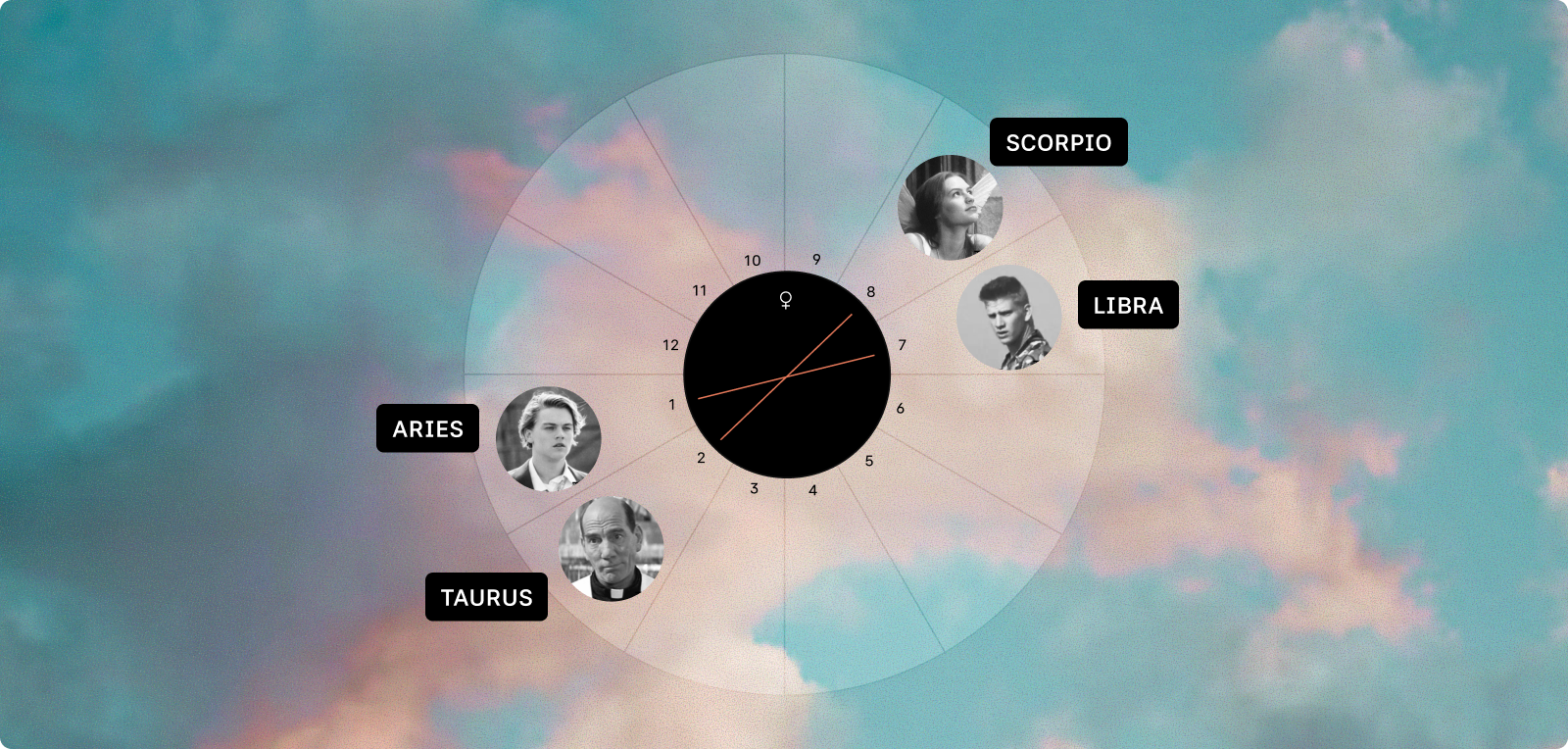
Finally, there is the exaltation and fall of a planet. Venus is revered in Pisces, where her potential for love and unification expands across dimensions. By contrast Venus struggles in Virgo, a sign for specification and calculation. We’ll see this play out less in specific characters, but more in the environment they operate within. But first…
Enter: Benvolio. Romeo’s cousin and confidant. He represents Venus in Libra. The cardinal air sign as is visually reinforced by the yellow color of the car he drives and the shirt he wears (yellow being the color associated with the Air element in the Rider Waite Smith Tarot). True to the cardinal modality, he is the first major character to show up and kicks off the play. He tempers the aggression of the Montague boys reminding them, “The quarrel is with our masters”. But it is lost on them. When the rival gangs threaten to fight eachother, he’s quick to de-escalate the situation: “Part, fools!” He then appeals to Tybalt to help him, “Manage to part this men with me”.
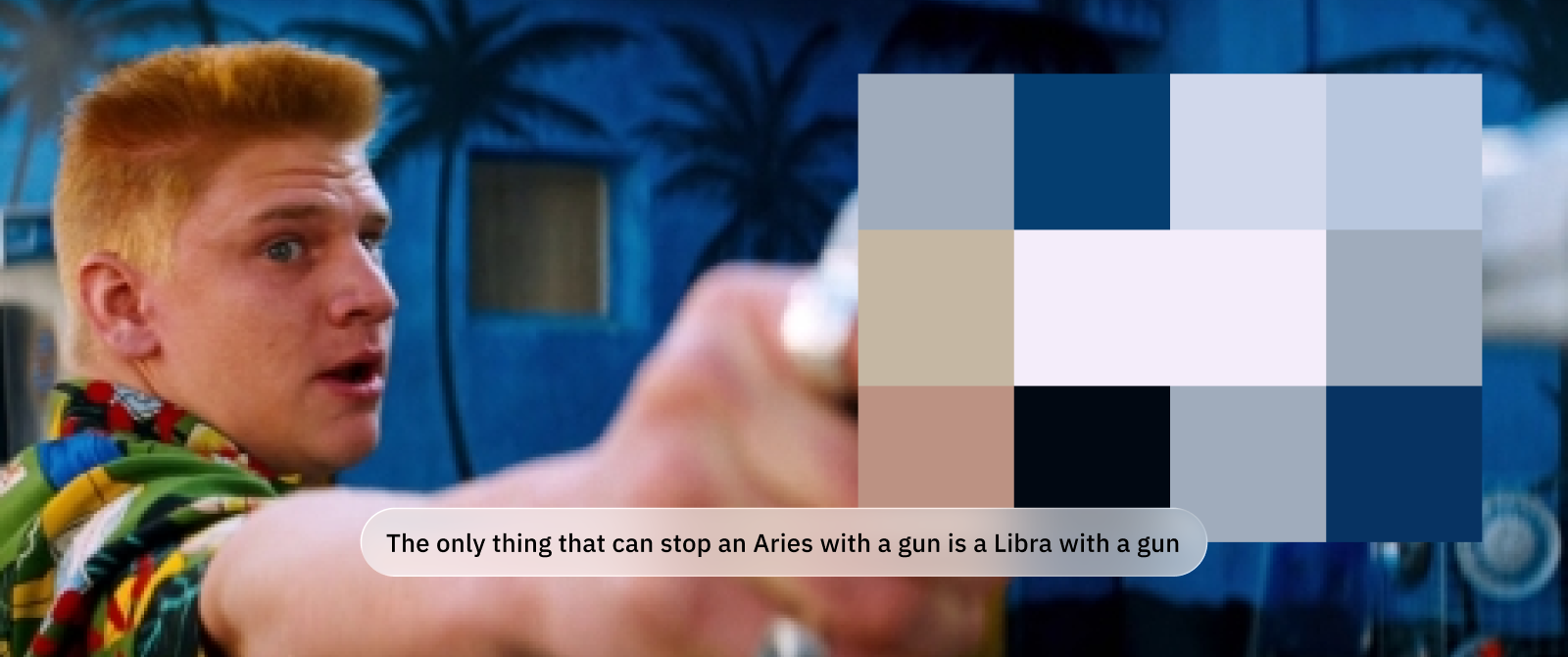
Benvolio’s negotiation skills are parried by Tybalt’s fiery criticism, as he exposes the hypocrisy between Benvolio’s words and actions: “What, drawn and talk of peace?” In other words, “go fuck thyself, Benvolio”. The fight at the gas station concludes in a great explosion, as is to be expected when air and fire elements collide. Prince Escalus intervenes and threatens death upon the next agitator. In Verona, violence and division is the mechanism of maintaining war as much as it is maintaining peace. Tybalt perpetuates the ancient grudge between the houses with eye-for-an-eye vigilante justice while Benvolio perpetuates the status quo through the appearance of peace.
Mercutio—aka Mercury, and hands down the best character in the story—clocks this. He calls out how Benvolio performs peace but is, “as hot a jack in thy mood as any in Italy”. Like a good Gemini, Mercutio has receipts for every time Benvolio started a “quarrel” over the dumbest shit: “Thou has quarreled with a man for coughing in the street… with another for tying his new shoes with an old ribbon.” (How on point for a Libra to get pissy about a fashion faux pas.) They then debate about which of them is quicker to argue. You know, typical air-sign conversation.
In the fallout of the big battle between Tybalt, Mercutio, and Romeo, Prince Escalus turns to Benvolio to assess the situation. In the film, Benvolio is soaked from the rain, shell-shocked from witnessing two deaths. He is emotionally spent, exhausted not only by this latest quarrel but by a lifetime of trying to live up to his namesake: the “good-willed” one. He is exhausted trying to keep the peace in a world of conflict, trying to lift his cousins’ spirits when he was heartbroken, trying to be an honorable nephew to the house of Montague, trying to stay true to himself in the crowd. This is the burden of a perpetual people pleaser.
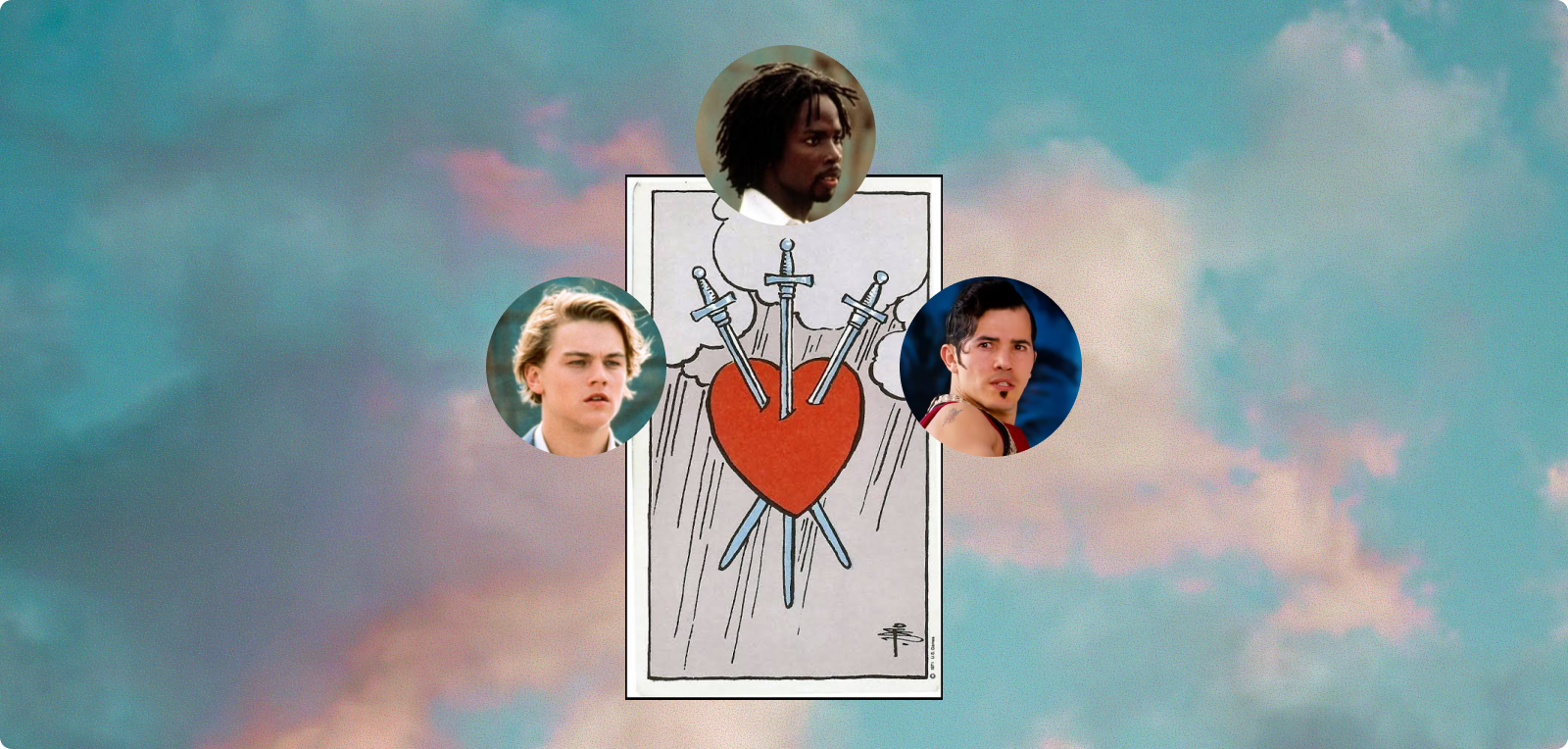
The tarot card associated with Libra II Decan comes to mind with its stormy, symmetrical heartbreak. The three of swords, known as the Lord of Sorrow, speaks to the pain of competing commitments, universal suffering, and the potential for healing after the storm has passed. With the Prince’s ear, Benvolio is in a position of power where he can control the narrative. Such is the responsibility and privilege of the storyteller. Despite how distraught he might feel, he chooses his words tactfully, knowing they carry a heavy consequence.
Libras are skilled negotiators because they are an inherently relational sign, able to see and appeal to another person’s perspective. The Prince’s name Escalus is linked to the Latin scala (“stairs” or “ladder”). If the Prince is at the top of the authority chain, Benvolio knows he must speak to him with deference in order to win his favor. He addresses him as “O noble Prince” and portrays Romeo, his cousin, as “speaking fairly” with “gentle breath” not wanting to displease the prince’s laws. While he paints Tybalt as being martial and “deaf to peace”. He concludes, “This is the truth, or let Benvolio die.” In contrast to Lady Capulet’s emotional damnation of Romeo, his is the more effective strategy. The Prince responds to Lady Capulet, “I will be deaf to pleading and excuses.” Thus, Romeo is exiled.
You’ll notice the Prince makes no attempt to investigate why Tybalt wanted to dual Romeo in the first place. The Montague boys—Benvolio included—infiltrated the Capulet’s party the night before under the guise of night and costumes. This wasn’t against any written law but it was a clear violation of a social boundary. Something I imagine Benvolio was anxious as hell about doing.
In contrast to the rest of the guys drunkenly donning Viking helmets, Benvolio is very briefly seen dressed as a priest. In Tarot terms, you might associate it with the Hierophant—another Venus-ruled card but associated with Taurus. The Hierophant represents conformity, tradition, and operating within established social structures. Day or night, this is essentially Benvolio’s modus operandi. Even here at a party where he is free to explore other identities and let go a little Benvolio still wants to be, and be seen as, a righteous figure.
After Romeo and Juliet’s deaths, the Prince declares, “A glooming peace this morning with it brings.” With the big family feud finally over, what purpose does Benvolio the peacemaker serve? His commitment to doing the “right” thing likely saved his life and that of his kin most days, but it did little to critique or dismantle the larger systems at play. At worst, it might have unintentionally upheld the conflict he sought to resolve. Perhaps this is why they say the road to hell is paved with good intentions. At the end of the day, it is Benvolio, the Venus in Libra, who survives the “bloody fray” but at what cost? He must turn inward to the conflict of his sword-stricken identity and heal in the stillness of a gloomy peace.
*Post-colonial astrology Alice Sparkly Kat.
This work could not have been written without the expertise of my parasocial astrological teachers Chris Brennan, Alice Sparkly Kat, Austin Coppock and Kira Ryberg, . ✨